Its own identity
A worker gets its own profile, its own email account, and a role — support, research, outreach, monitoring. It works its inbox the way a person would, and everything it does is visible on the team dashboard.
 SwarmMarshal
Agent workforces are the loudest idea in software right now — and most of them are a hosted gateway you cross your fingers about. SwarmMarshal's workers are the calm version: each one is a real hire running in its own supervised process on a computer you own, approval-gated, spend-capped, and able to borrow compute from every machine on your desk.
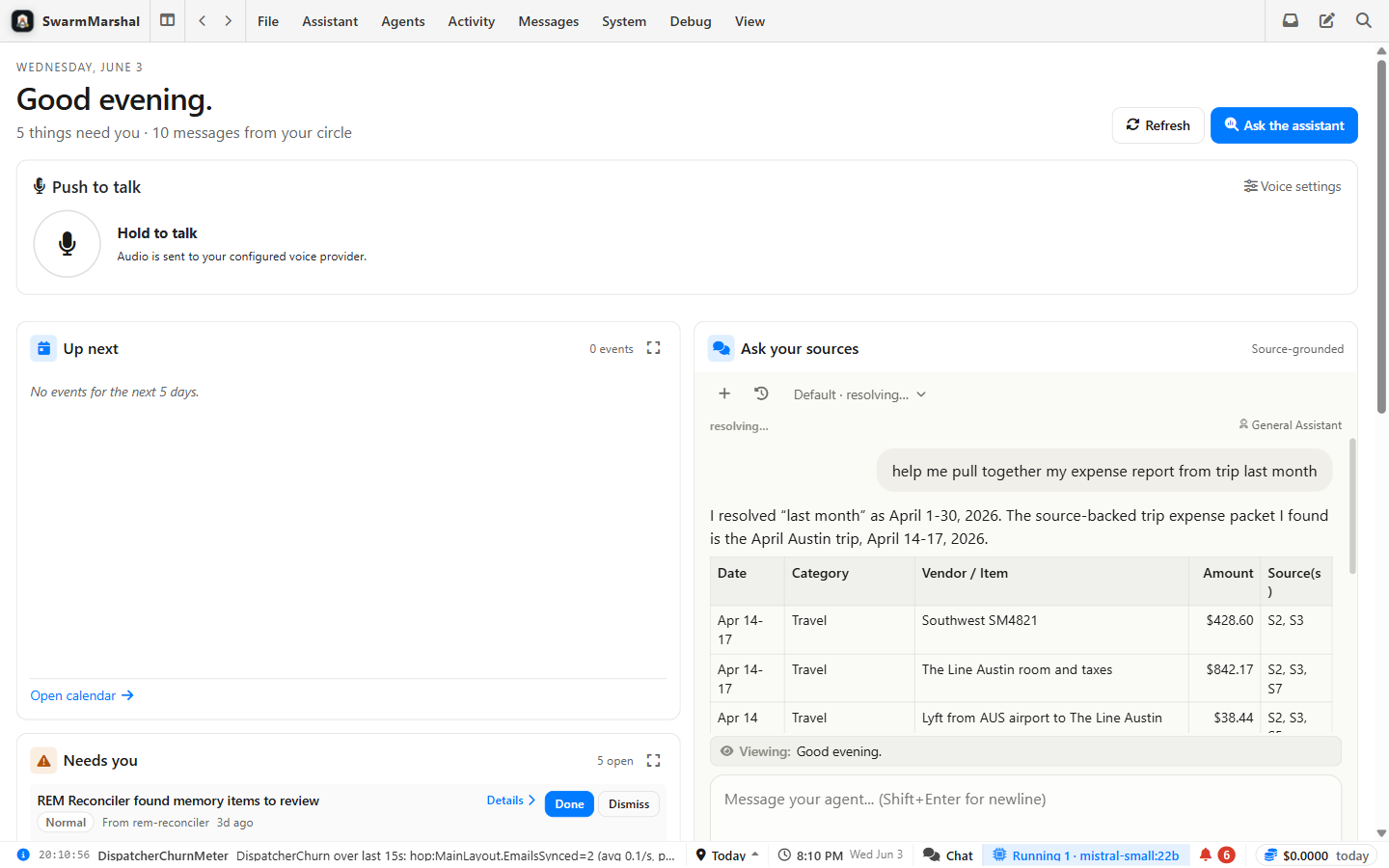
A worker gets its own profile, its own email account, and a role — support, research, outreach, monitoring. It works its inbox the way a person would, and everything it does is visible on the team dashboard.
Each worker runs in a separate child process with a curated set of services, a heartbeat, and restart-with-backoff supervision. One worker wedging doesn't take the others down — and closing the app stops them all.
Tell the assistant what you need and it stages the hire — profile, account, role — then waits. Nothing activates until you approve the hire, and pasted credentials are scrubbed from chat history and never travel through approval payloads.
Pair your Mac and PC once and they behave like one operation — while every worker stays exactly where you put it.
Same-owner devices pair on your LAN and talk with signed, authenticated messages. State replicates with journaled sync, offline machines catch up when they return, and fresh machines bootstrap from a snapshot.
A worker is bound to the device that hired it and never syncs to another machine — containment by design. The machine that hired a worker is the only machine that can run it.
Peers see each other's presence, and you can hand a chat or a job to an agent on another machine. SwarmSpan extends the same fabric with clipboard, file handoff, and peer work requests.
The unglamorous kind of distributed computing: no Kubernetes, no cloud bill — the machines on your desk sharing models, work, and results.
Paired machines advertise which local models they can serve. An LLM call on your PC can run on the Mac's Ollama install — and a worker can ask its boss machine to broker a cloud model without ever holding the API key.
Scheduled agent tasks, research jobs, and background work go through a peer work allocator that scores each node's load and hands the job to the machine best placed to run it.
When two machines see the same new mail, short-lived work claims make sure only one pays to process it — and the result syncs to both. Cloud calls are deduplicated, never forwarded machine-to-machine.
Laptops close. Journaled sync catches peers up when they wake, snapshot healing repairs gaps, and big files stream in resumable, hash-verified chunks — multi-gigabyte safe.
Desktops running SwarmMarshal can volunteer their local models to your company's SwarmMarshal CRM — admin-approved, opt-in per machine — so routine team AI questions run on hardware you already own at zero per-token cost.
Presence, heartbeats, work queues, sync state, and per-worker activity are inspectable in the app. When something fails, you get a diagnosis — not a silent gap.
The famous failure modes of self-hosted agent gateways are an exposed port, a token-burning heartbeat, and a bill you find out about later. Each one is designed out here.
“I started building SwarmMarshal because I found the agent gateways everyone was excited about unusable. This is the version I could trust on my own machines.”
— Scott Crossen, creator of SwarmMarshal
There is no public gateway. Machines talk only to paired, same-owner peers on your local network with signed messages. The attack surface a hosted agent gateway carries simply isn't there.
The always-on part of the system is deterministic — schedulers, sync, the enrichment pipeline. A model is invoked when there's real work, not on a timer that burns tokens to ask "anything to do?"
Spend caps apply per worker and per model, routine work prefers free local routes, and paying per message is off unless you turn it on. A runaway worker hits a wall, not your card.
Download SwarmMarshal, tell the assistant what you need done, and approve the hire. It runs on your machine — and stops when you say stop.